

Poultry consume feed to meet their energy and nutrient requirements. Although the type and amount of feed intake vary depending on species, age, genetic strain, and production purpose (broilers, layers, or breeders), there are fundamental physiological mechanisms that regulate feed intake in both the short and long term.
The dietary energy level is generally the most important factor influencing feed intake on poultry farms. Feed consumption is largely determined by the caloric density of the diet; as dietary energy increases, feed intake typically decreases, and vice versa.
Poultry are able to regulate their feed intake with relatively good accuracy according to their energy requirements. Therefore, any factor that affects energy demand will directly influence feed consumption. Among these factors, ambient temperature and stocking density are considered the main on-farm variables affecting energy requirements and, consequently, feed intake. Low environmental temperatures or high stocking densities increase energy demand and feed intake, whereas high temperatures usually reduce feed consumption.
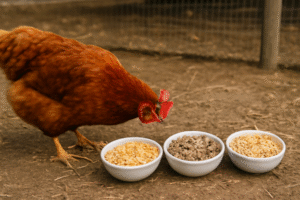
All commercial poultry regulate their feed intake with relatively good accuracy in order to balance nutrient consumption with their physiological requirements. In the short term, feed intake may fluctuate in response to changing conditions; however, over the long term, feed intake regulatory mechanisms are highly precise. Matching nutrient requirements with feed intake is an inherent and fundamental evolutionary necessity to ensure survival and reproduction.
Daily feed intake ultimately determines a bird’s health status, growth performance, body composition, and egg production potential. Diets are typically formulated based on an expected level of feed consumption. If birds consume less feed than the established standards or target values, they rarely achieve their maximum genetic potential. Therefore, understanding the mechanisms that control feed intake is essential for the design of effective feeding programs and for evaluating the potential impact of these regulatory mechanisms on different farm production systems
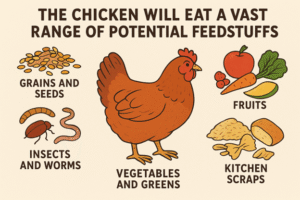
Feeding Behavior, Feed Selection, and Regulatory Mechanisms in Poultry
Poultry are omnivorous, meaning they consume a wide variety of foods. Seeds and plant materials often constitute the primary components of their natural diet. However, poultry also readily ingest insects and small amphibians. The ability to utilize a broad range of feedstuffs represents an evolutionary adaptation that helps poultry cope with seasonal fluctuations in nutrient availability. Nevertheless, omnivory does not imply indiscriminate feeding; observational studies consistently demonstrate that birds exhibit selective behavior when choosing specific feed particles and subsequently deciding whether to ingest them. Feed selection is influenced by multiple factors, including taste, texture, and nutrient composition.
The capacity of poultry to self-regulate their diet was meticulously investigated by Dove (1935). When birds were provided with ad libitum access to approximately 15 conventional feedstuffs, each presented separately in self-service feeders within the cage, daily feed intake and nutrient consumption remained remarkably consistent, although minor variations occurred due to individual feed choices.
Feed Taste and Texture
Certain compounds are inherently aversive to poultry, such as tannins present in sorghum, and flavors associated with fungi or cinnamon. Texture, however, is a principal determinant of feed choice and intake. Chicks generally avoid very large particles, whereas older birds tend to reject very fine particles. Across all age groups, poultry initially consume the largest particles offered, often leaving finer particles to accumulate in feeders. This innate preference can be strategically leveraged to modulate feed intake.
Poultry also exhibit positive responses to novel feed textures, particularly when these are incorporated as part of the diet. This phenomenon can be applied advantageously in practical feeding strategies. For instance, the consumption of coarse limestone by laying hens is likely linked to the novel texture of these particles, especially in finely ground diets. Similarly, during heat stress, the addition of molasses or even water to feed can temporarily stimulate intake, largely due to changes in feed texture.
Regulatory Mechanisms
While feed texture and particle size strongly influence initial feed selection, complex biochemical processes ultimately regulate intake. A laying hen typically consumes approximately 110 g of feed daily, whereas a 40-day-old broiler consumes about 250 g per day. Gastrointestinal fullness can have a minor impact on short-term feed intake. Handling the crop of a 15-week-old broiler breeder two hours post-feeding might suggest that crop fullness contributes to satiety. However, there is limited evidence supporting a substantial effect, as the crop contains virtually no neural terminals necessary to initiate the feeding-control mechanisms. Consequently, the influence of crop fullness on feed intake is minimal.
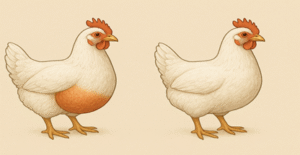
Nutrient Digestion and Feedback Mechanisms in Poultry
Upon ingestion, feed digestion in poultry commences almost immediately, with complex dietary components being broken down into their simpler chemical constituents, primarily sugars, amino acids, and fatty acids. As these basic nutrients circulate in the bloodstream, they interact with specific receptors in the brain that convey the bird’s nutritional status. For instance, following feed digestion and the consequent rise in blood glucose levels, a signal is transmitted to the bird to initiate feed intake reduction. Similar regulatory mechanisms are believed to operate for amino acids and, potentially, fatty acids.
Amino acid status is particularly noteworthy. Amino acids must be supplied in appropriate ratios—a concept commonly referred to as balanced protein. An imbalance in these ratios compromises the bird’s ability to efficiently utilize amino acids for growth or egg production. In such scenarios, the brain detects the imbalance and, as a protective mechanism, feed intake is reduced. For example, in laying hens, diets deficient in methionine result in a marked decrease in feed consumption, reflecting the bird’s physiological recognition that egg production cannot proceed efficiently with unbalanced protein.
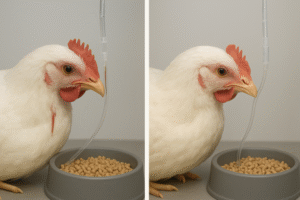
Amino Acid Imbalance, Nutrient-Specific Appetite, and Hormonal Regulation in Poultry
Experimental evidence has clearly demonstrated the impact of amino acid deficiencies on feed intake in poultry. When imbalanced amino acid mixtures are administered directly into the carotid artery, they reach regulatory sensors in the brain almost immediately, resulting in a rapid reduction in feed intake. In contrast, when the same imbalanced amino acids are delivered via the jugular vein, their effect on feed intake is minimal, as the liver has the opportunity to intervene and partially rebalance the amino acids before they reach central neural sensors.
Maintaining a specific level of body fat likely influences long-term (week-to-week) feed intake. Poultry also exhibit nutrient-specific appetites. The most well-documented example is calcium in laying hens. Upon initiation of egg production, hens demonstrate an increased appetite for calcium. Depending on dietary conditions, a laying hen can adjust her feed intake to achieve a daily calcium intake of approximately 4 g. For instance, when dietary calcium is slightly deficient, the hen compensates by increasing her overall feed consumption. This innate ability to sense and adjust nutrient intake represents a protective mechanism aimed at maintaining long-term health.
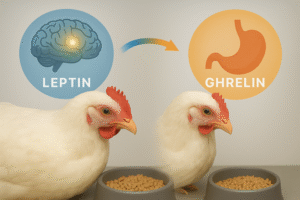
Two hormones appear to play central roles in these regulatory systems: leptin, produced in the brain, and ghrelin, primarily secreted in the proventriculus. Both hormones are considered essential mediators of feed intake regulation. Current research suggests that, beyond their role in appetite control, leptin and ghrelin may also influence reproduction and immune function in poultry.
Dietary Energy Level and Feed Intake Regulation in Poultry
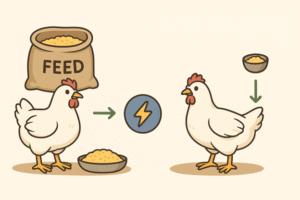
Under most commercial feeding conditions, the dietary energy level is the primary factor influencing feed intake in poultry. As previously described, an intrinsic regulatory system precisely controls the bird’s “daily” energy requirements. With increasing dietary energy density, birds reduce their feed intake, whereas a decrease in dietary energy stimulates higher consumption. This mechanism is consistent across poultry types and ages and operates with remarkable accuracy.
In laying hens, precise adjustments in feed intake in response to changes in dietary energy concentration can occur within 1–2 days. Consequently, the selection of dietary energy density represents an important economic decision and explains the variation in energy concentrations used in poultry diets worldwide. Notably, changes in feed intake in response to energy density typically necessitate corresponding adjustments in the intake of other nutrients to maintain nutritional balance.
For broilers, diluting the diet by 50% results in birds consuming approximately twice the amount of feed, thereby maintaining consistent energy intake. Broilers are able to fully regulate their feed intake, ensuring that energy consumption remains relatively constant regardless of diet formulation. The limiting factor in this context is the bird’s physical capacity to ingest the diluted feed. On commercial farms, it is generally impractical for broilers to consume twice the volume of a 50% diluted diet, thereby imposing practical constraints on reducing dietary energy density.
Environmental Temperature and Energy Demand in Poultry
Because poultry regulate their feed intake precisely according to their energy requirements, any factor affecting energy demand has an immediate impact on daily feed consumption. For example, when a laying hen temporarily ceases egg production for a single day, her feed intake decreases by approximately 30 g.
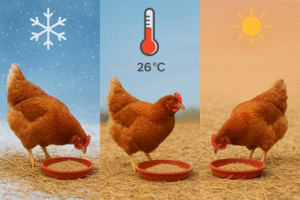
A primary determinant of energy requirements is ambient temperature. Following the rearing period, the optimal temperature for laying hens is approximately 26 °C. At temperatures below this level, birds require additional energy to maintain body temperature, whereas feed intake proportionally decreases under warmer conditions. Roughly, poultry adjust their feed intake by about ±1% for each ±1 °C deviation from the optimal temperature. For a laying hen, this corresponds to an approximate 1 g change in daily feed intake per 1 °C change in ambient temperature, which underscores the importance of maintaining thermally controlled housing for laying hens.
Environmental Temperature and Energy Demand in Poultry
Because poultry regulate their feed intake precisely according to their energy requirements, any factor affecting energy demand has an immediate impact on daily feed consumption. For example, when a laying hen temporarily ceases egg production for a single day, her feed intake decreases by approximately 30 g.
A primary determinant of energy requirements is ambient temperature. Following the rearing period, the optimal temperature for laying hens is approximately 26 °C. At temperatures below this level, birds require additional energy to maintain body temperature, whereas feed intake proportionally decreases under warmer conditions. Roughly, poultry adjust their feed intake by about ±1% for each ±1 °C deviation from the optimal temperature. For a laying hen, this corresponds to an approximate 1 g change in daily feed intake per 1 °C change in ambient temperature, which underscores the importance of maintaining thermally controlled housing for laying hens.
Feather Molt and Its Impact on Feed Intake Calculations
Feather molt can significantly influence feed intake calculations, particularly under colder environmental conditions. For instance, at 15 °C compared to 26 °C, a laying hen experiencing poor feather coverage may consume approximately 10 g more feed per day than a bird with good feathering.
Conclusion
In summary, reductions in feed volume induced by enzyme supplementation do not lead to overconsumption; rather, they can result in decreased feed intake. This is because poultry regulate their intake based on energy requirements rather than feed volume. Consequently, enzyme supplementation not only enhances dietary energy availability but also reduces feed consumption, thereby improving economic efficiency for poultry producers.

