
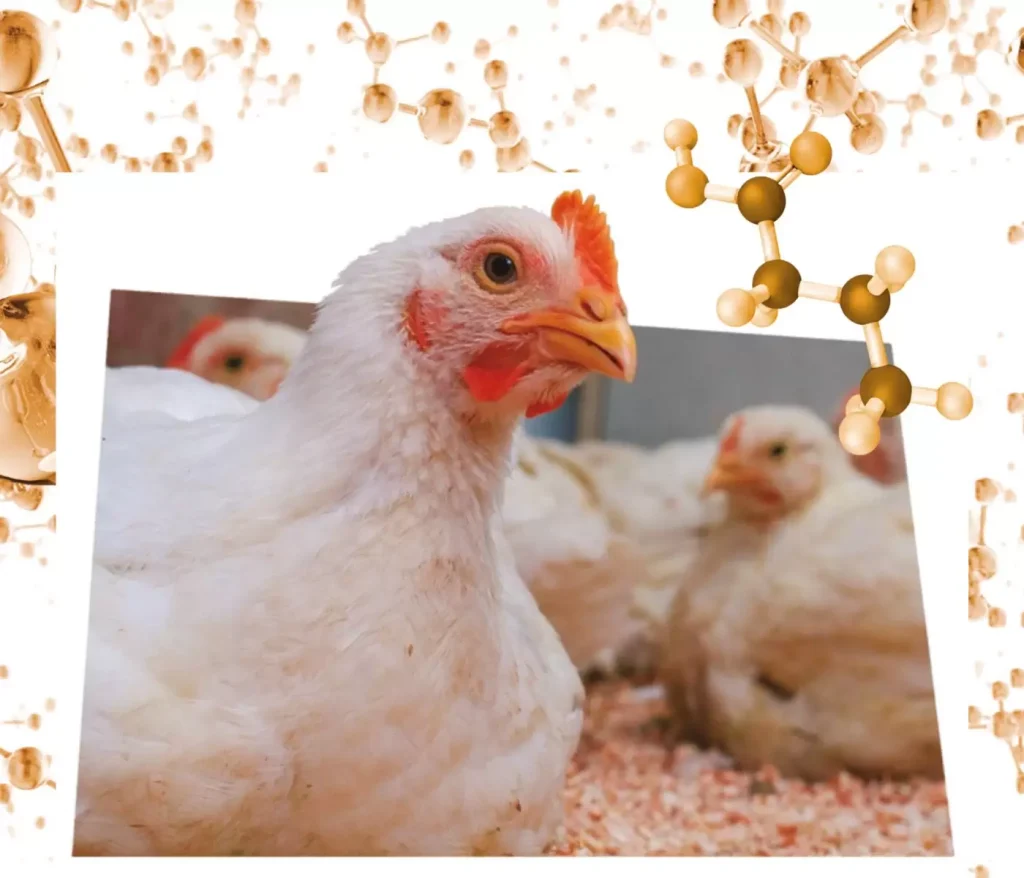
in low protein diets in broiler chickens
Since natural sources of protein are limited, and given the increasing demand for animal proteins, various strategies must be used to increase diet efficiency while reducing its environmental impact. Abandoning traditional livestock feeding methods of the past and switching to modern feeding strategies can play an important role in providing the protein needed by the human population and meeting environmental needs.
Why use amino acids instead of protein?
Reducing crude protein (CP) in the diet while adding essential amino acids (AA) to meet the nutritional needs of broilers is one of the methods that can help preserve natural resources and the environment in addition to meeting the basic needs for chicken growth:
1– Reduced nitrogen excretion: When crude protein is reduced but essential amino acids are adequately supplied, the amount of nitrogen excreted through feces is reduced, which reduces environmental pollution.
2– Improved nutritional efficiency: Adding specific amino acids such as lysine, methionine, threonine and tryptophan instead of crude protein provides more efficient absorption and utilization of nutrients.
3-Saving natural resources: Reducing the use of natural protein sources (e.g., soybean meal) helps preserve natural resources and puts less pressure on feed producers in terms of feed costs.
Reasons for the adverse effects observed on growth in studies:
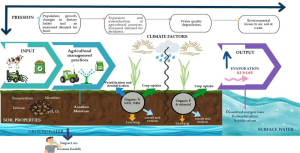
Due to nitrogen excretion by animals, environmental regulations emphasize the use of strategies such as feeding low-protein diets to minimize nitrogen excretion. However, in some studies conducted on animal nutrition and reducing crude protein in the diet, Adverse effects on growth and carcass quality have been demonstrated in broiler chickens.
A number of hypotheses have been discussed as possible reasons for the effects of reduced protein (in the diet) on broiler performance:
1- Difference in essential amino acid ratio between experimental diets
2- Use of specific non-essential amino acids
3- Use of free amino acids compared to peptide-bound amino acids
What is Glycine Equivalent Concentration:
Glycine Equivalent concentration in the diet and levels of metabolic precursors of glycine (such as serine) have received significant attention over the years in improving nutritional requirements to maximize animal growth.
This short article reviews the progress of studies related to low crude protein diets, focusing mainly on studies published over the past two decades on factors affecting the conversion of non-essential amino acids such as glycine and serine in broiler diets.
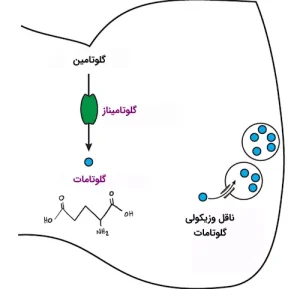
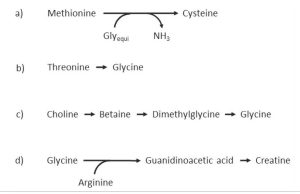
Glycine and serine can be converted into each other in the one-carbon metabolism pathway.
For this reason, in diet formulation, these two amino acids are often considered together as Gly+Ser or Glyequi.
The nutritional role of glycine in improving poultry growth has been well recognized over the past decades. Given the shared metabolic pathways between glycine and serine, evaluating these two amino acids together provides a more accurate perspective for determining the physiological value of diets. For this reason, in diet formulation, their sum is usually used as “glycine equivalents” (Glyequi).
Glyequi (g/kg) = glycine (g/kg) + [0.7143 × serine (g/kg)]
The role of threonine
Several researchers have proposed different requirements for these amino acids over the past two decades.
The observed differences in optimal Glyequi concentrations in broiler diets reported in different studies are likely to be explained by differences in the levels of endogenous glycine precursors; among these, threonine (threonine) and choline play the most quantitative role.
When diets are limited to providing only essential amino acid requirements, it becomes important to better understand the relationship between Glyequi and threonine.
In this section, we review the results of three studies:
1- A study by Seigert et al. (2015) showed that different combinations of Glyequi and threonine can lead to specific levels of feed conversion ratio and daily weight gain. In this study, increasing the level of threonine in the diet reduced the need for Glyequi to achieve the desired physiological responses.
2-Corzo et al. (2009) reported that in diets formulated with low crude protein levels, the negative effects of glycine deficiency can be compensated by using moderate amounts of threonine in the diet. In this study, the interaction between low Gly+Ser and moderate threonine improved body weight, carcass and breast meat.
3- However, the findings of Van Haren et al. (2018) were not consistent with these results.
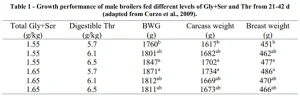
In their study, the addition of 0.7 g threonine per kg of low-protein diet containing Gly had no effect on the growth performance of male broilers.
Given the continuous need of growing chicks for food sources containing glycine throughout all stages of growth, paying attention to factors affecting endogenous glycine reserves in the bird when formulating diets can be a way to further optimize and improve nutrition.
Potential for Choline to Glycine Conversion
Studies have shown that:
- Choline can be converted to glycine in large quantities in mammals (Melendez-Hevia et al., 2009).
- Despite the obvious importance of glycine in poultry nutrition, little is known about the interaction of choline, glycine, and threonine and their effect on the nutritional requirements of poultry.
Siegert et al. (2015) examined the following data using a quadratic regression model:
- When the choline content is constant (1.05 g/kg dry matter):
o Threonine requirement varies between 8.2 and 9.3 g/kg, depending on the Glyequi concentration varying between 19.5 and 22.9 g/kg.
- Conversely, when Glyequi is constant (19.5 g/kg):
o Threonine requirements vary between 8.8 and 9.5 g/kg, depending on the variation in choline content from 1.03 to 1.72 g/kg.
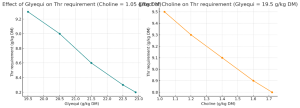
The findings of this paper are an effective step towards optimizing the concentration of glycine equivalent (Glyequi) in diets. The role of other nutrients affecting the response to Glyequi has also been considered.
These optimizations allow:
- The crude protein (CP) content of the diet to be reduced without compromising the growth performance of broilers.
- The negative impact of livestock production on the environment is reduced.
- Producer costs are reduced. (Click here to learn about other cost reduction methods)
This article, by reviewing recent studies, showed that reducing the crude protein content in broiler diets, if essential and non-essential amino acids are accurately supplied, not only leads to maintaining growth performance, but can also help reduce production costs and reduce nitrogen excretion, and consequently negative environmental impacts.
Among these, the role of glycine and serine as non-essential amino acids is very important. These two amino acids are metabolically interconvertible and play a role in vital pathways such as the synthesis of purines and creatine. Although they are synthesized endogenously, in conditions of low protein nutrition, the need to supply them through the feed increases.
Also, sources of glycine precursors such as threonine and choline can play a role in meeting the physiological needs of the animal to some extent, but the adequacy of these sources depends on metabolic conditions and overall diet composition.
Meanwhile, the addition of feed enzymes such as proteases, amylases, and especially cell wall degrading enzymes such as xylanase and beta-glucanase, can help meet the animal’s real needs by increasing nutrient digestibility and better release of amino acids. Enzymes also improve the usability of plant resources and reduce dependence on expensive protein sources.
As a result, the simultaneous use of a protein reduction strategy with a precise balance of amino acids and the addition of appropriate enzymes to the feed is considered a sustainable and cost-effective nutritional approach to increase productivity in the poultry industry.

