

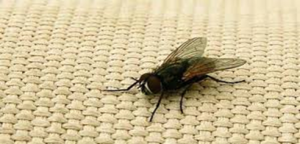
Flies pose a health risk to humans and poultry. They carry Salmonella, Pasteurella, Campylobacter and E. coli, which have a negative impact on poultry flocks and farm personnel. The rate of reproduction of flies can vary depending on environmental conditions such as heat, humidity and food sources, but 5 to 6 generations can be expected during a breeding season, such as summer.
Birds that are constantly exposed to flies may become agitated and restless, which can negatively affect their ability to feed, drink water, and lay eggs. In other words, fly infestations in poultry farms can reduce the number of eggs harvested daily and the weight gain of broilers, thereby reducing overall poultry productivity.
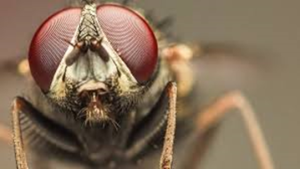
The key to preventing fly infestations is managing water and humidity in the litter. Farms that keep the litter dry rarely experience serious fly infestations. A proper fly control program ensures that moisture in the litter is controlled and fly breeding sites are eliminated. Keep in mind, insecticides can help temporarily reduce fly populations but cannot be the only effective fly management method.
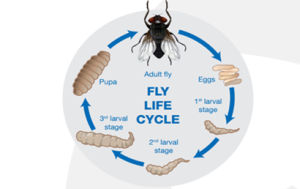
It should be noted that the presence of 25 to 75 flies per 300 square meters indicates the need to take measures to eliminate flies. It is best to use a comprehensive and well-written program for fly control that includes techniques such as:
1- Hygiene and fly expulsion
2- Chemical fly control methods (insecticides)
3- Painting method
4- Control of food and bedding
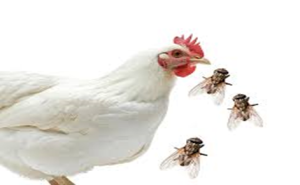
– Hygiene and fly control
1) Hygiene is the first line of defense against flies in poultry farms.
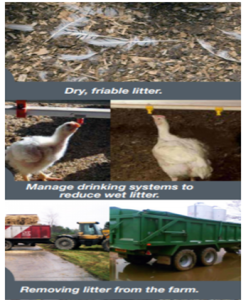
– If possible, food, litter, broken eggs, and waste on which flies lay their eggs should be removed.
– The remaining litter after cleaning should be managed in such a way that it remains dry and free of fly eggs.
– Managing the height of drinking systems and monitoring water flow rates will help reduce the creation of wet bedding.
– Drinking systems should be checked regularly to ensure there are no leaks.
– Litter removed during unloading shall not be stored on the farm or spread on adjacent fields. It shall be transported in a tarpaulin-covered trailer at least 3.2 km (2 miles) away from the farm and disposed of in accordance with sanitary regulations.
– Feed spills should be cleaned up immediately.
– Flock losses should be removed from the house as soon as they are discovered.
– Any broken eggs should be removed from the hatchery immediately to prevent attracting flies.
2) Flies can also be removed from the house using ultraviolet light or a fan.
– Extractor fans that direct air flow outwards will prevent flies from entering the house.
– Curtains should be placed on entrance doors, windows and entrances.
– Chemical methods of fly control
1) Insecticides are an effective method of reducing the number of flies present and are a key component of a good biosecurity program.
Insecticide baits are usually composed of a mixture of insecticide, sugar, and attractants (pheromones). Two types of insecticides are used in the poultry industry (residue and non-residue):
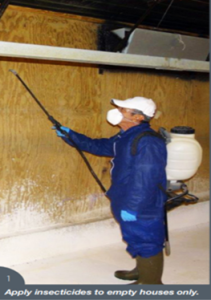
Insecticides with Residues
Residual insecticides should only be used in empty sheds.
Sheds should be thoroughly cleaned and disinfected before using insecticides.
Protective clothing, face masks, gloves, hats, and eye protection should be worn when using insecticides.
Mix the insecticide concentrate with clean water according to the manufacturer’s recommendations.
Apply to non-absorbent surfaces of the spray area such as hardwood, painted or coated walls.
Leave the area and allow the insecticide to dry completely (2-3 hours).
(These products are harmless to poultry and humans once dry.)
Insecticides remain effective for 2-3 months.
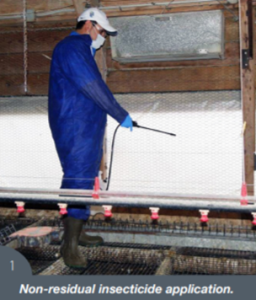
Non-residue insecticides
Non-residue insecticides are only effective when used at the time of application and do not have long-term effectiveness. They are most effective when initial elimination of a large population of adult flies is necessary. In this case, a non-residue insecticide should be used before using a residual insecticide.
– Like residual insecticides, this program is only suitable for indoor treatment in an unoccupied location.
– Thermal foggers can be used to distribute residual insecticides throughout the home.
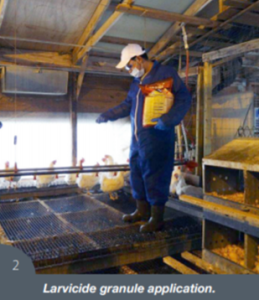
2)Larvicides are also an effective chemical method of fly control.
Larvicides only control fly larvae and are usually applied as a spray or as a spread on manure under the slats in hatcheries or directly on the bedding in broilers. Some things to consider when using larvicides include:
They are more effective on younger larvae than older larvae, so timing is important. The best time to apply the first treatment is 2 weeks after the birds are brought into the house.
Larvicides are slow-acting and may take 1 to 2 weeks to take effect.
Due to the risk of flies developing resistance, only two complete litter treatments are recommended during the life of each flock.
3)Rotate insecticide products
A variety of insecticides with different modes of action or active ingredients reduces the risk of resistance.
Use a different mode of action insecticide every 2 to 3 generations of flies (approximately every 6 to 9 weeks) (unless otherwise directed by your veterinarian or health care professional).
Attracting flies with paints and attractants (painting method)
– Contains attractants that encourage flies to land in the desired trap.
– Kills flies within minutes of contact, including flies that are resistant to other chemicals.
– Paint on attractants cannot be used in areas where birds can access them.
– Apply the sorbent to clean surfaces where flies rest: walls, window sills, and furniture.
– Paint sorbents can also be painted onto bags, cardboard, or fabric and hung in areas where flies are infested.
* Avoid using in windy locations such as near fans or cool cells, as flies tend to prefer warmer locations with less air movement.
*The paint on the fly catcher should be reapplied every 3-5 days, depending on the level of infestation.
Feed and litter control
In general, litter is a mixture of manure and poultry waste, feathers, and cellulose materials. If the moisture content is not standardized or the poultry feed is not standardized, the resulting waste will have high moisture content, which creates a suitable substrate for the growth and reproduction of fly larvae.
Litter is a valuable nutritional source containing high levels of nutrients such as nitrogen, phosphorus, potassium and calcium, hence poultry litter is used to increase the fertility of agricultural land. Also, the type and components of the diet, such as the amount of protein and fat, affect the composition of feces. These components, in turn, can affect the moisture content of the excreta and, consequently, the moisture content of the litter.
Other Fly Control Methods
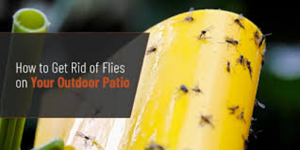
– Adhesive Hanging Fly Paper
Fly paper is coated with a sweet, fragrant, highly sticky, non-toxic substance that traps flies when they land on it.
– Ultraviolet Shell Zappers
Used in receiving areas, processing areas, egg rooms, and other areas.
Electric zappers attract flies with long-wavelength ultraviolet light and kill them with an electric shock.
Depending on the device’s specifications, ultraviolet fly zappers are suitable for indoor and outdoor use.
Electric fly zapper units are effective during the day and night, attracting insects from a coverage area of up to 150 square meters (1,615 feet).
Resources
https://www.thepoultrysite.com/articles/best-practice-on-the-farm-fly-control
https://jasbsci.biomedcentral.com/articles/10.1186/s40104-021-00576-0

